
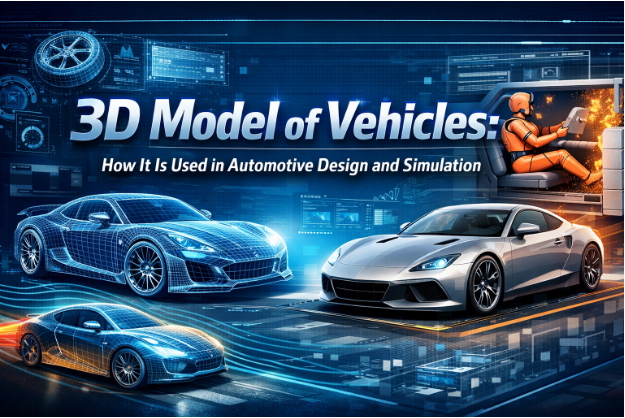
Automotive engineering and manufacturing undergo exponential advancement at an unprecedented pace, given the innovations being witnessed in design, safety, and performance.
Right at the core of this wave is the 3D model of vehicles, where designs and development related to vehicles happen digitally before any prototype is put into place.
Vehicle modeling has now become an important part of the automotive industry, right from the conceptual designs of the car to the simulation validation of the vehicle.
In what Contexts is a 3D Model of Vehicles Used?
3D vehicle models are detailed virtual representations of a car, truck, or any kind of vehicle made with precise geometry. 3D vehicle models can be conceptual, ranging from detailed visualizations to precise assemblies with thousands of components.
Based on usage, a 3D model of vehicles can depict:
- Exterior and interior design surfaces
- Structural and Mechanical Components
- Engine, transmission, and suspension designs
- Complete assemblies of vehicles for simulation purposes
These models form a common digital platform for design, engineering, and test teams.
Involvement in Automotive Concept and Design Development
The use of 3D models is employed by designers to analyze designs in terms of proportions, body lines, and wind tunnel. Experts in this field make use of digital sculpting to design models of cars.
In interior design, 3D modeling assists in visualizing:
- Dashboard layouts
- Seating ergonomics
- Driver Visibility and Comfort
- Space utilization
In the digital environment, design decisions can be reviewed and made faster than in a physical environment because they can be accessed quickly and made instantly.
Engineering & Mechanical Validation
After reaching a design direction, working with a 3D model of cars switches to engineering. Details of mechanisms and structures are created with exact sizes.
This facilitates engineers’ ability to:
- Verify clearances and component interaction
- Weight Optimization & Structural Integrity
- Ensure Manufacturability
Digital assemblies help decrease errors that normally come up during physical prototyping.
Car Modeling and Performance Evaluation
One of the most successful uses of vehicle models is simulation. Realistic 3D models are used as an input for advanced engineering analysis tasks.
Common examples of such simulations include:
- Aerodynamic testing (airflow and drag analysis)
- Crash and Impact Simulations
- Testing and research on suspensions and vehicle dynamics
- Thermal and vibration analysis
In this way, through digital simulation of real-world operating environments and outcomes, predictions can be made as to expected performance and safety characteristics and then validated in a series of lab tests to avoid continual.
Facilitating Autonomous and EV Cars
With the mainstreaming of electric vehicles and autonomous technology, modeling in autos has gained immense importance.
3D models are employed for:
- Integrate Battery Packs & Electric Drives
- Validate sensor location for cameras, radars, and LiDARs
- Simulating autonomous driving scenarios
- Optimize vehicle weight and energy efficiency
Digital car simulations can test new technologies quickly and easily prior to their use with real vehicles.
Manufacturing Planning and Production Readiness
Before mass-producing a vehicle, a virtual replica of it is used for manufacturing preparations.
The 3D model of vehicles is applied for:
- Tooling and fixtures design
- Assembly line planning
- Robotic automation programming
- Quality Inspection Planning
This helps achieve a seamless transition from design to mass production.
This further helps avoid costly changes that occur at a later stage.
Aside from engineering, vehicle models are also shared across other departments.
They support:
- Professional marketing images and animations
- Virtual showrooms
- Configurators
- Assembly and maintenance simulation trainings
- Technical documentation and manuals
This is because one digital model can be repurposed for these different applications, thus optimizing return on investment.
Simulation-Based Design Iteration
Computer models of autos enable designers to work more quickly and safely. Designers can examine several designs side by side before settling on a favorite version.
Which results in:
- Quick turnaround cycles
- Minimized material waste
- Enhanced final vehicle performance
Simulation-driven iteration has emerged as a key competitive advantage in the automotive industry.
Outsourcing’s Place in Vehicle Modeling
Car modeling demands a degree of engineering detail and high-level visualization skills. For mass production and handling intricate workflows, many car manufacturers and component suppliers have opted for offshore 3D game art services with expertise in hard-surface and car modeling skills.
Outsourcing teams assist by:
- Developing high-detail automobile assets
- Aiding simulation-capable modeling
- Providing visualization models for marketing and training purposes
- Scaling the production process while in the peak development phases
Outsourcing, when integrated with engineering standards, can be a strong addition to existing capabilities.
Long-Term Value Throughout the Vehicle Life Cycle
The 3D model of a vehicle is highly useful not only during production but also after it is put into production.
It supports:
- Maintenance planning
- Spare part design
- Future Upgrades and Face-lifts
- Regulatory documentation
This will make modeling automobiles an investment in digital property rather than designing it once.
Conclusion
Vehicle modeling is a major aspect of three-dimensional technology used today in the automotive industry. This technology starts from the design phase of the vehicle up to the manufacturing phase.
With the help of specialized partners who provide 3D game art outsourcing services, the automotive sector can then readily expand its car models quickly while being accurate and precise. In a sector where innovation, speed, and safety are paramount, it is not a recommendation to model cars properly—it’s a necessity to create cars for the future.